Posts

In review--Sensitives grow roots

Image
I'm posting the following book review here because people with accute sensitivities respond well to music therapy and sound healing.  In addition, musicians are also sensitive and can benefit from the wisdom presented in this book. Dr. Judith Blackstone Belonging Here A Guide for the Spiritually Sensitive Person Sounds True Where was Dr. Judith Blackstone and Dr. Judith Orloff (who also writes about sensitivities), back in the 1990s when I began experiencing acute sensitivities? Back in the 1990s the concept of sensitivities, especially environmental sensitivities were seen as a neurosis of hysterical housewives.   This did not help me in employment where my employers saw me more as a troublemaker than a sensitive person with talents and useful skills.   I did not enjoy living in my body due to the abuse I suffered daily because of my sensitivities and it wasn’t until I took a workshop at the Women of Wisdom conference in Seattle that I learned about...

In review--Love for all relations

Image
Cheevers Toppah True Melodies Harmonized Songs from the Heart of Native America Canyon Records Native American traditional singer Cheevers Toppah (Kiowa/Navajo), captured my attention several years ago with his solo and collaborative efforts with Alex E. White and Nitanis Landry ( Harmony Nights , Canyon Records).   Similar to other Native American men vocalists, Toppah’s voice glides effortlessly between bass and baritone, while bringing soothing timbre to his harmonized songs.   As any singer will tell you singing a cappella and harmonizing with their self provides challenges, especially in the area of intonation.   Toppah’s training as a choral singer along with his years of honing Native American vocal traditions brings us a confident singer with a powerfully healing voice.   There are no shortages of healing voices on Canyon Records or among Native American musicians in general, Toppah joins the cream of the crop while also bringing his int...

In review--Honoring indigenous women

Image
Fawn Wood Iskwewak Canyon Records Fawn Wood (Cree and Salish lineages) represents a new and powerful voice on Canyon Records. Along with her husband Dallas Waskahat and her Native American musician family members, Wood honors indigenous women on her CD, Iskwewak (means all women in the Cree language).   Her collection of mostly round dance songs sung in Plains Cree, vocables and English, reflect on the different situations women face from participating in relationships with the “wrong man” or honoring elders, as in Grandmother Song .   Mostly, Wood sings about love for her husband and for her baby son. I cannot emphasis enough the beauty and power in Wood’s vocals, along with her sense of humor, and songwriting skills.   The text to Mr. Wrong cracks me up every time I hear it, especially the line “Mr. Wrong with five kids on the side...” However, most of the songs fall on the tender side expressing love and appreciation for relations.   If y...

In review--The Gypsy Experience

Image
Bratsch Urban Bratsch World Village I was in the mood for gypsy jazz just when the French group Bratsch’s new recording Urban Bratsch arrived in my mailbox.   A delicious mix of klezmer, gypsy jazz, German theater (Brecht/Weill), and Eastern European music, this quintet delivers a whopper of a recording. It is as eclectic as Lo-Jo, and as rousing as Les Yeux Noirs (also from France).   These guys show what passions are possible played on acoustic instruments (guitar, accordion, violin, double bass, and clarinet). The opener Sirba Din Joc De Constanca/Hora certainly starts off a rousing listening experience with its gypsy violin.   I expect to hear one of those wild and crazy Eastern European zithers conversing with the violin, but in all honesty, this music fills the space just fine.   Francois Castiello’s accordion resembles a harmonium on the ballad Scetate with Nano Peylet’s klezmer clarinet singing mournfully along with the raspy vocals...

The Practice--Intent, intent, intent...

Image
photo by Patricia Herlevi I watched Jonathan Goldman’s 2004 DVD Healing Sounds (Program 1)-- Sacred Mysteries last night.   In this DVD, Jonathan mentions that frequency + intention = healing.   I have come across several articles and books on the frequency aspect of this equation, but not enough research on intention.   It is not a coincidence that in ancient Egypt and other ancient civilizations that musicians and sound healers went through rigorous training and were initiated into their musical roles.   These musicians learned about the power of sound, frequency, and intent, along with the power of words.   Yet, how many educators these days know anything about this power? As a writer and as a musician, my teachers did not teach me about this hidden power in music, at least not the ones, outside of the new age arena. I plan on founding a music cooperative in the Bellingham, Washington area where these aspects of sound and music will be taugh...

In review--Your brain on audio

Image
Dr. Jeffrey Thompson Music to Change Your Brain (Sound Healing/Brain Science) Sounds True Doctor of Chiropractics Jeffrey Thompson began experimenting with sound scientifically in the 1980s, according to the press notes that accompanied a media copy of Music to Change Your Brain .   Thompson uses audio to alter brainwaves to create feelings of relaxation or alertness.   His audio CDs which include bi-aural devices, intended tempo, and ambient sounds have helped millions of people relax, fall asleep, meditate, and heighten creativity.   Music to Change Your Brain offers six 10-minute tracks that include, Alpha Relaxation System, Healing Mind System, Creative Mind System , Awakened Mind System, Gamma Meditation System , and Delta Sleep System .   So how do these tracks affect a sensitive person such as me? I know my readers and colleagues are weary of my aversion to synthesizers, but I wouldn’t practice integrity if I ignore the fact that syn...

In review--Music of the Atlantic Diaspora

Image
Pancho Alvarez Sonche Atlántico Folmusica My sister introduced me to Galicia, a Spanish province, over a decade ago when she loaned me her copy of Paulo Coelho’s The Pilgrimage , but Angel Romero, Founder of World Music Central, introduced me to Galician music several years ago.   When many people think of Spanish music they think of flamenco or gypsy music.   I have not met many people outside of music journalism and world music audiences who even realize the diversity of musical traditions hailing from Spain’s provinces.   For instance, in Asturias and Galicia, bagpipes and large frame drums are prominent, but so are various types of lutes, accordions, strings, and instruments from other folkloric traditions.   The music ranges from jaunty sends-ups to haunting ballads.   At times, music of northwest Spain resembles other Celtic music of Scotland and Ireland. Multi-instrumentalist Pancho Alvarez features mostly original compositions on ...

In review--Learning how to swim in French

Image
Irène and Francis Jacob Je Sais Nager (I know how to swim) Sunnyside Communications/Universal France Brazilian bossa nova diva Astrud Gilberto and French actress Brigitte Bardot, though from two parts of the world, shared soft understated vocals in common.   In mainly the realm of Parisian actresses, breathy vocals were transformed into a vocal pop art.   Even the English alternative pop band Stereolab made this music hip back in the 1990s, then dubbed as French lounge music.   The days of Edith Piaf belting out torch songs had ended, replaced by film stars turned singer-songwriter.   French actress Irène Jacob ( Trois Coleurs Rouge and Double Life of Veronique ) has joined the French pop music tradition while joining forces with her musician brother Francis Jacob on Je Sais Nager . This world pop album combines suave bossa nova with North and West African flavors, while never allowing listeners to forget the French origins of the songs. ...

In review--Sons from Veracruz

Image
Radio Jarocho Cafe Cafe Chido Records When world music fans think of traditional Mexican music, they usually think of rancheras or mariachi, lesser known, son jarocho hails from Veracruz and weds the musical traditions of former African slaves, indigenous people, and European colonialists.   Distinct features of son jarocho include rapid call & response vocals sung slightly flat, equally rapid rhythms strummed on ukulele size lutes (requinto and jarana) or a Mexican harp and percussive rhythms created by dancing feet (zapateado).   The infamous La Bamba hails from Veracruz and this music tradition. I have mostly heard traditional versions of his music on Smithsonian Folkways recordings and on Conjunto Jardin’s Yerba Buena CD that featured both traditional and original son jarocho songs.   Hailing from the opposite coast in the US, Radio Jarocho has educated music fans in Washington, DC, New York, and Boston.   On the band’s recording Café Café , t...

In review--Swinging French

Image
Ben Powell New Street Independent/Ben Powell Music Perhaps it is not too strange that an English child prodigy-turned jazz player interprets French gypsy jazz, aka French swing.   Violinist (both classical and jazz), Ben Powell pays tribute to the legendary French violinist Stéphane Grappelli on his independent recording New Street.   However, New Street travels beyond a tribute album to French swing players, in that Powell honors American jazz legends too such as Thelonious Monk on Monk 4 Strings and adds classical music touches, such as the reference to Bach on the end of Judith. Powell performs with his quartet (Tadataka Unno on piano, Aaron Darrell on bass and Devin Drobka on drums) and with a Stéphane Grappelli tribute trio (Gary Burton on vibraphone and Julian Lage on Guitar) and by including both ensembles, Powell explores intriguing sonic territory.   One interesting side note, the trio performs Gary composed by Grappelli for Gary Burton who plays...

In review--Lute Songs under a Pink Moon

Image
Joel Frederiksen & Ensemble Phoenix Munich Requiem for a Pink Moon An Elizabethan Tribute to Nick Drake Harmonia Mundi Curiosity reared its head when I received press information about the early music ensemble lead by Lute player Joel Frederiksen covering the folk songs of Nick Drake.   After researching the modern revival of early music and folk traditions from the 1960s and 1970s, I already knew about a fusion between early European and folk music, and in fact, famous folk songs, Greensleeves and Scarborough Fair hail from the renaissance.   However, Joel Frederiksen and Ensemble Phoenix Munich cross the paths of English folk musician Nick Drake (1970s) with the melancholic lute songs of the Elizabethan John Dowland on the folksy Requiem For A Pink Moon , titled after one of Drake’s classics. In case you are wondering about the overall effect, the songs take on a 1970s folk revival feel despite the musicians performing the songs on early music instruments...

In review--Forbidden Singers

Image
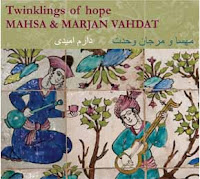
Mahsa & Marjan Vahdat Twinklings of hope Kirkelig Kulturversted (Norway) Not legally permitted to share their immaculate vocals with the Iranian public, the Vahdat sisters have recorded and released albums on the Norwegian label, Kirkelig Kulturversted.   In 2003, founder of KKV, Erik Hillestad, discovered the Iranian sister vocalists when he produced the album Lullabies from the Axis of Evil .   The album that brought light to the humanity present in the countries the former US President George Bush, Jr. deemed evil, launched the Vahdat sisters’ international career.   Since that time, the Vahdat sisters have released several recordings on KKV and their latest, Twinkling of hope features ancient and contemporary Persian/Iranian poetry performed on traditional instruments and sung in a traditional voice. The irony of the Iranian government’s law forbidding women to sing in public ensures that the Iranian people experience only half of their humanity....

In review--Elvis Revisited

Image
Lisa Dillan and Asbjorn Lerheim Love Me Tender (The Quiet Quiet Way) Kirkelig Kulturverksted I have not thought about Elvis Presley in years so I felt surprised when I received a Norwegian recording, Love Me Tender , paying tribute to Presley.   Vocalist Lisa Dillan and guitarist Asbjorn Lerheim headed to Nashville to record in the same studio the late Presley had recorded, and to work with the same musicians as Presley.   While this must have seemed like a dream manifested for Dillan, who became a Presley fan after the legend’s death in 1977, Dillan gives each song unique folk interpretations.   The musicians create a warm, relaxing and quiet atmosphere in which Dillan’s vocals caress every word.   A strong melody and evocative text translates into almost any musical style. Unlike, Dillan, I know little about Elvis Presley outside of the movies I saw as a child.   While you won’t hear Jailhouse Rock or Blue Suede Shoes on Love Me Tender , you will ...

Practice It--Power Songs Make You Strong

Image
Some music listeners prefer movie soundtracks for escape and healing purposes.  "The Sound of Music" gets the most mentions.  I have heard and read that the "Do re mi" song clears blocked chakras.  You can learn more about this in the late Ted Andrews' book, "Sacred Sounds". While Julia Cameron promotes morning pages (journaling therapy), I promote the concept of the music diary (keeping track of music's effects on your mind and body).  One of the tools that derives from the music diary is a set of power songs.  By tracking different music styles and songs on your mind, body, emotions, and neurological system, you discover at least 5 must-have songs that help you with insomnia, uplifting hour moods, energy-building, or for catharis (unblocking emotions). I give you an example of 5 of my power songs and their uses.  You might include these songs in your music tool kit or choose your own based on your musical observations.  I also mention t...

In review--Beats & Vibes

Image
Lucas Van Merwijk’s Drums Unlimited Heartbeat Tam Tam Productions As with all my Whole Music projects, I sometimes break musical components apart to explore the roles rhythm, tempo, timbre, color, melody, and harmony play.   A musician once told me that I had no sense of rhythm.   At first, I felt angry about this critical observation later, I started attending drum events in Seattle, and found that I could follow along just fine.   My heartbeat taught me all I needed to know about rhythm.   Lucas van Merwijk’s Drums Unlimited know all about those poly rhythmic beats, but this recording does not represent an improvised drum circle, but tightly woven pieces, even drum vignettes with vocals in some cases, and worldview of drum cultures. While I pass on the DJ mix type tunes on this recording, the acoustic drum pieces definitely excite me.   Listen to the effervescent African Dream with Gianna Tam scatting in an African dialect over the...

In review: Stevie's Wonderland

Image
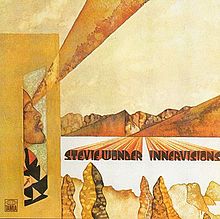
Stevie Wonder Innervisions Motown/Universal (1973) Ah, Stevie, how did I forget you for so many years? I grew up with Stevie Wonder music surrounding me.   Then when I was in college, I took a dance class and our final performance featured Sir Duke .   However, after I discovered alternative rock, I stopped listening to soul music, and poor Mr. Wonder was relegated to the back closets of my mind.   That was until a few months ago when I heard Sir Duke playing the background at the food coop.   Stevie was back and just in time, since now I decided to include a chapter on soul music for my book-in-progress, Whole Music . Oh, I’m enjoying this. When Stevie released Innervisions in 1973 I was in grade school, but I heard the gritty socio-commentary Living for the City , the catchy Don’t You Worry “Bout a Thing , and the funky Higher Ground on a pop radio station.   However, at the time I did not recognize Wonder’s musical genius.  ...

The Practice--Exploring Your Daily Soundscape

Image
Photo: By Patricia Herlevi I ask myself what are the chances that I will meet a didgeridoo player, enjoy exposure to crystal singing bowls at a spiritual shop, and encounter someone playing electric guitar on the sidewalk in one afternoon? Yet, one day last week, the sound universe revealed its diversity.  Along with that, I tracked my emotional and physical responses to the diverse encounters.  While I found the frequencies of the singing bowl and the didgeridoo relaxing and uplifting, the electric guitar (performing hard rock) did not appeal to my senses, and in fact, I experienced a fight or flight response.  I chose the flight. On another day, the sun came out and as I walked through a quaint neighborhood, I heard guitar blues coming over someone speakers, the music poured onto the street and some how, this felt like the right music for the right time and environment.  I bring these scenarios up because the majority of humans walk by musical sounds everyday...